The Digital Growth Framework: How SEO, GEO and Web Development Work Together
For many businesses, web development, SEO and digital marketing are still treated as separate projects.
A website is built by one provider. SEO is considered later. Advertising is managed independently. Booking systems, customer enquiries, analytics and internal processes may all operate through different platforms.
The result is often a collection of digital tools rather than a connected digital strategy.
Modern business growth requires a different approach.
A strong website needs to be technically accessible, easy to navigate and designed around customer action. SEO helps potential customers discover that website through traditional search engines. GEO helps make the business easier to understand and reference within AI-powered search experiences. Digitalisation then connects this visibility to practical systems such as online bookings, enquiries, eCommerce, customer management and performance reporting.
Together, these elements form a digital growth framework.
Digital Discovery Is Changing
Google Search remains an important part of how people find businesses, compare services and make purchasing decisions. However, search is no longer limited to a list of website links.
Customers can now use AI-powered search features and generative tools to ask detailed questions, compare providers and receive summarised recommendations.
Google reported in November 2025 that AI Overviews had reached approximately two billion monthly users. In May 2026, Google also published dedicated guidance for businesses, website owners and developers seeking visibility in generative AI search experiences. Importantly, Google stated that established SEO practices remain foundational to visibility within these newer search formats.
This does not mean that businesses should abandon SEO and focus entirely on GEO.
It means the website must work harder as a reliable source of information for customers, search engines and AI systems.
A Data Snapshot of the New Search Environment
Several developments help explain why businesses need a more connected digital strategy:
-
Google’s AI Overviews reached around two billion monthly users by November 2025.
-
The original academic study introducing Generative Engine Optimisation reported visibility improvements of up to 40% within its controlled generative-engine experiments.
-
A broader 2026 review cautioned that GEO results can vary significantly between platforms, prompts and contexts. It found that no single technique had yet demonstrated stable, long-term visibility gains across every generative platform.
-
Google’s structured-data documentation includes case studies where Rotten Tomatoes reported a 25% higher click-through rate for enhanced pages, while Nestlé measured an 82% higher click-through rate for pages appearing as rich results. These are individual case studies rather than guaranteed outcomes, but they show the potential value of giving search engines clearer information.
The practical lesson is clear: businesses should not chase temporary AI-search tricks. They should build a strong digital foundation that supports traditional search, AI discovery and customer conversion at the same time.
1. Web Development Creates the Foundation
Web development is not simply the visual design of a website.
It determines how quickly the website loads, how clearly information is organised, how easily search engines can access the content and how smoothly visitors can complete an action.
A strong business website should make it easy for a visitor to:
-
Understand what the business offers
-
Confirm the locations or areas it services
-
Review products, services or past projects
-
Find evidence of experience and credibility
-
Request a quote or make a booking
-
Contact the business from a mobile device
-
Move from information to action without unnecessary steps
Technical decisions also affect search visibility. Page structure, internal linking, mobile usability, metadata, image optimisation, structured data and indexability all influence how search engines interpret a website.
Google describes SEO as helping search engines understand website content while helping users decide whether they should visit the website. This means SEO should be considered during development—not added after the website has already been completed.
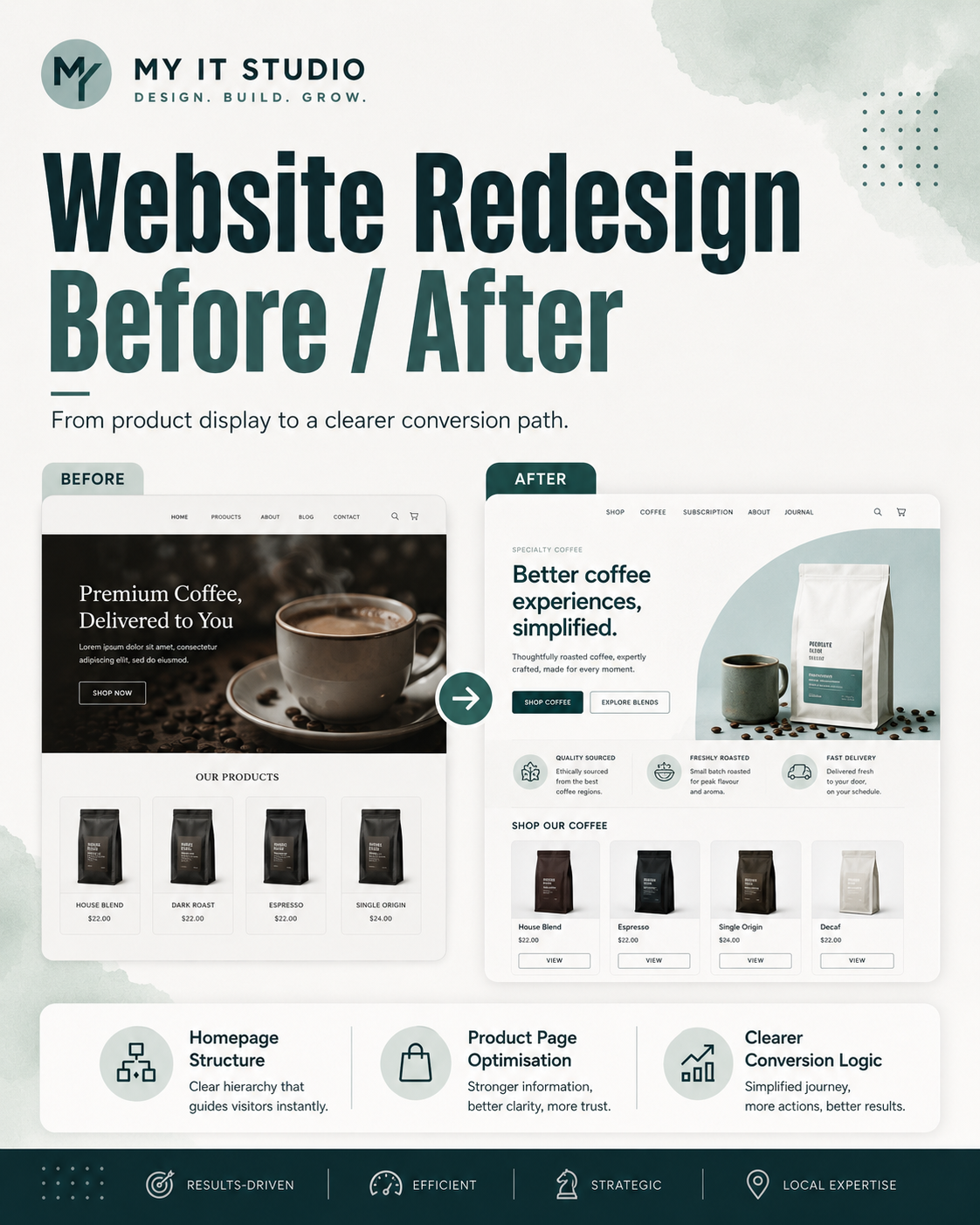
A visually attractive website with weak structure may struggle to rank. A website that receives traffic but has confusing navigation may struggle to convert. Development, visibility and conversion therefore need to be planned together.
2. SEO Connects the Website With Existing Demand
Search Engine Optimisation helps a website appear when potential customers are actively searching for relevant products, services or information.
Effective SEO begins with understanding customer intent.
A person searching for “web designer Hobart” may be looking for a local provider. Someone searching for “Shopify versus WordPress for a small business” may still be researching their options. Another person searching for “website redesign cost Australia” may be closer to contacting an agency.
Each search represents a different stage of the customer journey.
An effective SEO strategy connects these searches to the right pages through:
-
Keyword and search-intent research
-
Clear service and location pages
-
Helpful blog content
-
Accurate page titles and meta descriptions
-
Internal links between related pages
-
Technical SEO and mobile optimisation
-
Google Business Profile optimisation
-
Credible backlinks and third-party references
-
Regular content updates
-
Search Console monitoring
The Australian Government’s business guidance also recommends understanding online customers, using relevant keywords naturally, updating website content, earning reputable links and using accurate metadata.
SEO is not simply about increasing traffic. The objective is to attract relevant visitors who are more likely to become customers.
3. GEO Makes Business Information Easier for AI Systems to Understand
GEO stands for Generative Engine Optimisation.
It refers to improving how clearly and accurately a business, brand or source may be understood and represented within AI-generated answers.
Traditional SEO often focuses on appearing in search results. GEO considers whether an AI system can confidently understand questions such as:
-
What does this business specialise in?
-
Where does it operate?
-
Which customers does it serve?
-
What makes it different from competitors?
-
What evidence supports its experience?
-
Are its contact details and service information consistent?
-
Can its claims be verified through reliable sources?
GEO should not be treated as a shortcut or a replacement for SEO. Google’s 2026 guidance states that, from its perspective, optimising for generative AI search remains part of optimising the overall search experience. Google also warns that many supposed GEO “hacks” are unsupported or ineffective.
A practical GEO strategy therefore focuses on clarity, evidence and consistency.
This may include:
-
Publishing direct answers to common customer questions
-
Using clear headings and logical page structures
-
Adding meaningful statistics and properly attributed sources
-
Creating detailed service, product and location information
-
Publishing real case studies with measurable outcomes
-
Maintaining consistent business names, addresses and contact details
-
Adding appropriate organisation, article, product or local-business structured data
-
Strengthening credible mentions on relevant third-party websites
-
Clearly identifying authors, expertise and publication dates
-
Updating content when services, prices or business information change
The aim is not to manipulate AI systems. It is to become a clearer and more trustworthy source.
4. Digitalisation Turns Visibility Into a Working Business System
Visibility alone does not create sustainable growth.
A business may attract website visitors but still lose opportunities because enquiries are answered slowly, booking processes are confusing, customer information is stored manually or performance cannot be measured accurately.
Digitalisation connects marketing activity with business operations.
Depending on the organisation, this may include:
-
Online booking and appointment systems
-
eCommerce and online payments
-
Automated enquiry notifications
-
Customer relationship management systems
-
Inventory and order management
-
Quotation or application forms
-
Email follow-up workflows
-
Analytics and conversion tracking
-
Internal dashboards and reporting
-
Custom web applications
-
ERP or operational management systems
The website becomes more than a marketing brochure. It becomes part of the way the business attracts, serves and retains customers.
This is where web development, SEO and GEO begin producing operational value.
How the Four Elements Work Together
Consider a potential customer searching for a professional service in Hobart.
SEO helps the business appear for a relevant Google search.
Clear content and structured business information help search engines and AI tools understand what the company offers.
A professionally developed website gives the customer confidence and presents the right information in a logical order.
A streamlined booking or enquiry system makes it easy to take the next step.
Analytics then records the enquiry, allowing the business to understand which channel, page or campaign contributed to the result.
The complete journey is:
Discovery → Understanding → Trust → Action → Measurement
When one stage is weak, growth becomes more difficult.
A business may rank well but have a poor website. It may have a beautiful website that receives little traffic. It may generate enquiries but have no reliable system for tracking or following them up.
The digital growth framework addresses the complete journey rather than one isolated metric.
What Businesses Should Measure
A connected digital strategy should be measured against business outcomes rather than vanity metrics alone.
Useful measurements include:
Search Visibility
-
Search impressions
-
Keyword positions
-
Local search visibility
-
Indexed and eligible pages
-
Organic clicks
Customer Engagement
-
Engagement with important service pages
-
Contact-button clicks
-
Product or service views
-
Booking-page visits
-
Form-start and form-completion rates
Conversion Performance
-
Qualified enquiries
-
Confirmed bookings
-
Online purchases
-
Phone leads
-
Cost per lead
-
Revenue generated
Website Performance
-
Mobile usability
-
Page-loading performance
-
Broken links
-
Indexing issues
-
Form and checkout completion
-
Core Web Vitals
AI and GEO Visibility
-
Accuracy of AI-generated business descriptions
-
Brand mentions in relevant AI answers
-
Citation and source appearances
-
Consistency of business information
-
Visibility across repeated, realistic customer questions
GEO measurement remains less standardised than traditional SEO measurement. Results can change according to the platform, wording and timing of a question. Businesses should therefore monitor trends across repeated tests rather than relying on one isolated AI response.
Building a Sustainable Digital Growth Framework
A practical implementation can be divided into four stages.
Stage One: Establish the Digital Foundation
Review the website structure, technical performance, mobile experience, service information, contact pathways and analytics setup.
Stage Two: Improve Search Discoverability
Develop a keyword strategy, strengthen important service and location pages, optimise metadata, publish helpful content and improve local SEO.
Stage Three: Strengthen Authority and AI Readiness
Add evidence-led content, clear business information, FAQs, case studies, author details, structured data and reputable third-party references.
Stage Four: Connect Marketing With Operations
Integrate bookings, enquiries, customer management, automation, eCommerce and reporting so that digital visibility leads to measurable business activity.
This staged approach allows businesses to prioritise the most important improvements without treating every new digital trend as a separate project.
Why an Integrated Approach Matters
MY IT STUDIO positions its services around ROI and real results rather than clicks and impressions alone. Its current services include web design and development, web application development, SEO and digital marketing, supported by more than 500 completed jobs and customers.
This integrated service model is increasingly important because website design, search visibility, AI discovery and business systems now influence one another.
A website should support marketing. Marketing should generate measurable customer actions. Customer actions should connect with practical business systems. Data from those systems should then guide the next stage of improvement.
That is how a collection of digital tools becomes a digital growth framework.
Final Thought
Businesses do not need to choose between SEO and GEO.
They need a strong website, accurate information, useful content and connected digital systems that make the business easy to discover, understand, trust and contact.
SEO supports visibility in traditional search. GEO helps prepare content for AI-assisted discovery. Web development provides the technical and conversion foundation. Digitalisation connects the entire journey to real business operations.
The strongest digital strategy is not built around one platform or one short-term trend. It is built as a connected system that can adapt as customer behaviour and technology continue to change.
Discuss Your Digital Growth Strategy With MY IT STUDIO
MY IT STUDIO helps Australian businesses develop professional websites, improve SEO visibility, strengthen digital marketing and create practical digital systems designed around real business outcomes.
Services include:
-
Website design and development
-
WordPress and Shopify development
-
SEO and local SEO
-
Digital marketing
-
Web application development
-
eCommerce solutions
-
Booking and enquiry integrations
-
Business process digitalisation
Contact and Booking Details
MY IT STUDIO PTY LTD
Phone: 03 6169 5503
Email: info@my-it.com.au
Hobart Office:
Level 2, Room 5
64–68 Liverpool Street
Hobart TAS 7000
Launceston Office:
92 Cameron Street, Civic Square
Launceston TAS 7250
Office visits are available by appointment only. Customers can arrange a consultation through the Schedule a Consultation option on the MY IT STUDIO website or submit an enquiry through the online contact form.
Suggested CTA Button:
Book a Digital Strategy Consultation
Alternative CTA Button:
Discuss Your Website and SEO Goals